Airborne Traffic Monitoring.
Leveraging Drones for Real-Time Highway Insights
Our team is developing a hexacopter for highway monitoring that brings together aerial imaging, onboard machine learning, and real time telemetry. The goal is to identify roadway hazards from a mobile platform while addressing the practical engineering challenges of power, sensing, communication, and flight safety.
California State University, Fresno · Caltrans sponsored senior design · Faculty advisor: Professor Roger Moore
Team: Reet Brar, Andrew Caraveo, Carlos Cortes, and Alexandre Widman
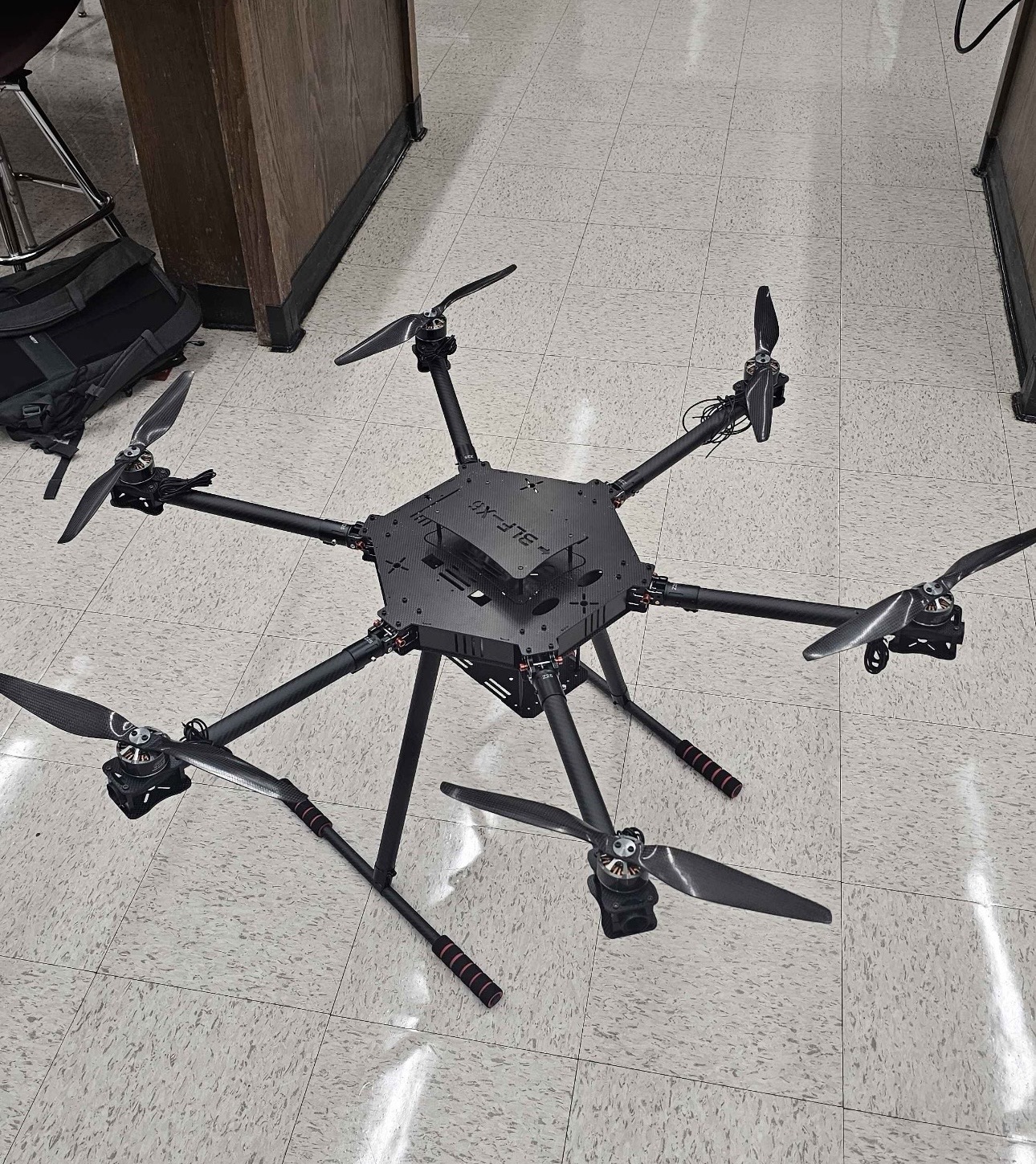
The six motor hexacopter platform during development. The frame is shown before final avionics and payload integration.
Why this project?
Highway incidents, debris, and other roadway conditions can be difficult to assess quickly using fixed cameras alone. We are exploring how a remotely operated drone could provide an additional aerial perspective, collect imagery, and support machine vision based hazard identification.
Rather than relying on a commercial drone as a finished product, our team is developing the platform around its own electrical, computing, and sensor architecture. This allows us to study the integration challenges firsthand, from distributing power to the propulsion system to processing camera data onboard.
System design
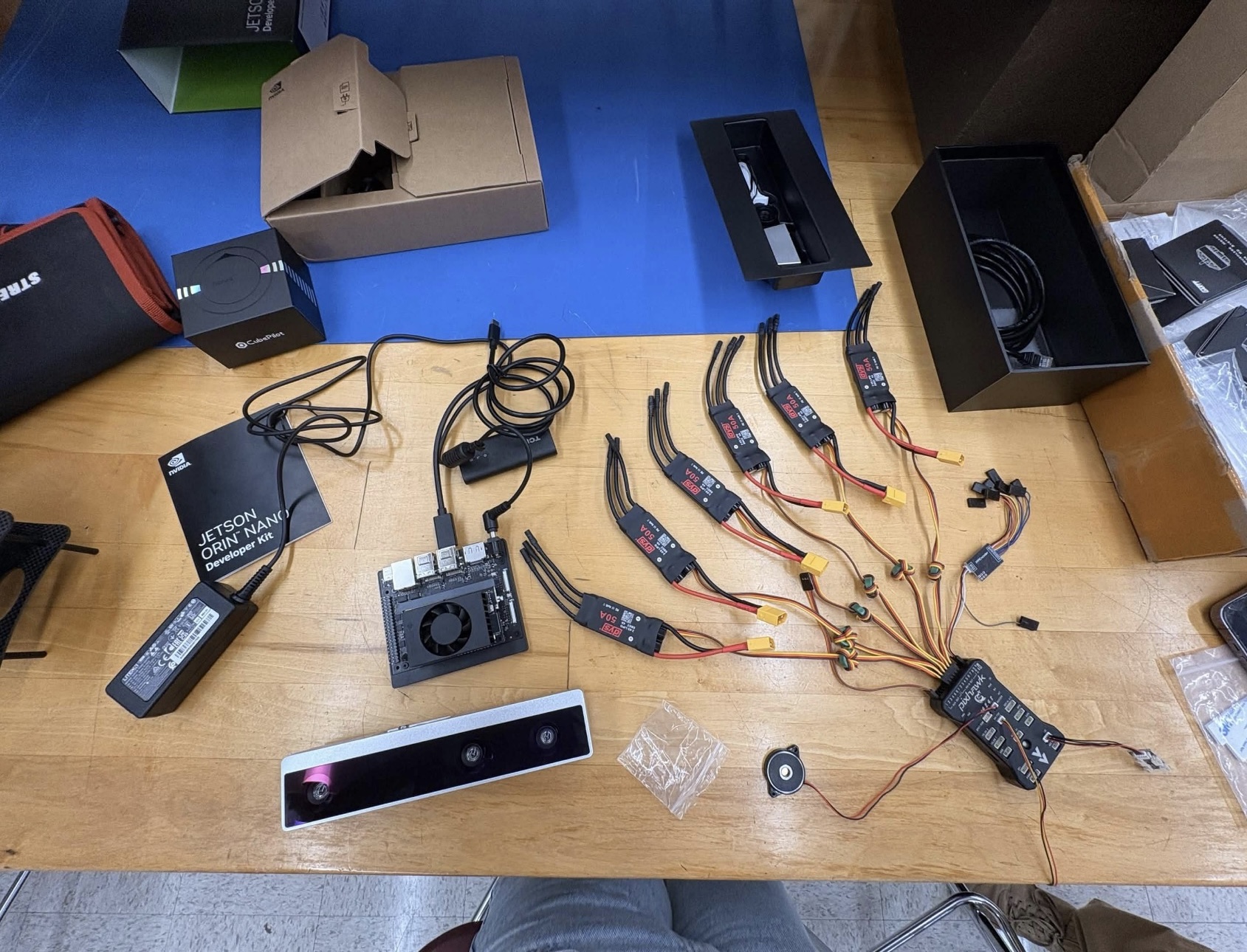
The current design uses an X960 hexacopter frame with six motors and electronic speed controllers. Two 6S batteries are planned to feed a custom power distribution PCB, which is designed to supply the propulsion system and regulated power for the flight electronics.
A Pixhawk flight controller manages aircraft stabilization and pilot control. The NVIDIA Jetson Orin Nano Super handles the planned computer vision workload, using an OAK-D LR stereo camera for image and depth information. A Livox LiDAR sensor is also selected for environmental ranging.
The power board is routed, but final design rule checks, component footprint verification, and manufacturing readiness remain open tasks. Subsystems will be verified individually before full integration.
Machine learning and vision
My primary technical focus is the onboard vision pipeline. The planned processing flow is to capture RGB and stereo depth information with the OAK-D LR camera, process it on the Jetson using Python and DepthAI, and apply YOLO object detection to identify potential roadway hazards in camera imagery.
Working with an onboard computer introduces constraints that are easy to overlook during model development. Detection accuracy matters, but so do inference time, available memory, thermal performance, and the stability of the camera connection. Once the pipeline is operational, these will be measured rather than assumed.
The Jetson has been powered on, accessed through Ubuntu, and connected to the network. The software environment is being prepared for camera acquisition and model inference. Live camera processing and trained model performance are not yet presented as completed results.
My contributions
As team lead, I help organize project priorities, coordinate work across our subsystems, and keep track of dependencies between hardware and software. I also work directly on machine learning and navigation logic, particularly the Jetson environment, camera processing workflow, and plans for passing detection information to the flight controller.
One lesson from this project has been how closely connected these tasks are. A vision system can work well in isolation, but its usefulness depends on reliable power, predictable data flow, and clear interfaces with the rest of the aircraft. That is why I have been approaching integration as part of the design process rather than treating it as the last step.
Verification and next steps
Our current scope is a remotely piloted aircraft with live video, telemetry, and an onboard hazard detection system. Fully autonomous flight is not part of the present project baseline. Before claiming a working end to end system, the remaining interfaces and performance targets need to be tested.
- Complete the OAK-D LR camera connection and confirm stable image acquisition on the Jetson.
- Set up and evaluate YOLO inference, including frame rate, processing latency, and hardware resource use.
- Define and test communication between the Jetson and Pixhawk.
- Verify power distribution, sensor mounting, telemetry, and ground station operation.
- Carry out controlled testing, followed by flight validation under the required safety approvals.
I'll add measured results, annotated imagery, and engineering diagrams as each stage is validated. For now, this page documents the actual design and integration work in progress.
Currently in the development and integration phase, with ongoing work in machine learning, onboard computing, and subsystem testing.